The space problem in urban areas
Before the technical detail, picture clearly the problem the three-level indoor go-kart model solves. A traditional kart track needs an area equal to several football pitches to make an interesting circuit, which is nearly impossible in the city center where rent is counted per square meter.
A quality kart track usually needs a large footprint, which is almost impossible to get in the city center with high rents. That is why most big kart tracks sit in the outskirts or neighboring provinces. The multi-level go-kart model came about to solve exactly this problem: keeping the track long enough to be interesting without needing a large footprint.
How the three-level model works
Instead of laying the track out horizontally on one floor, the three-level model uses the building's height, with karts moving through ramps between levels as part of the circuit. This design keeps the total track length comparable to a mid-size one-level track while the required footprint is considerably smaller.
The different experience of racing across levels
The biggest difference isn't only the track length. It is the feel of changing height during the race, something an ordinary one-level kart track can't offer. As the kart moves through the ramps between levels, the driver clearly feels the change in gravity and viewpoint, adding a layer of experience a flat track doesn't deliver.
Specific figures at Infinity Racing
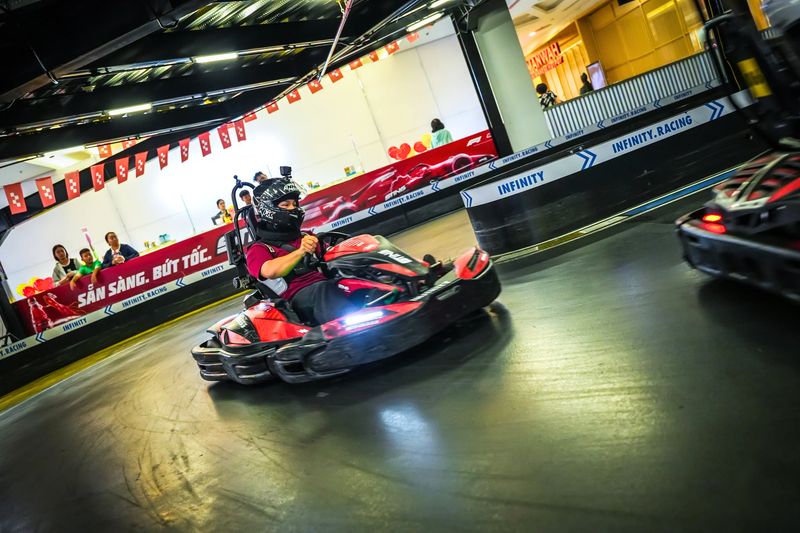
The three-level go-kart track at Infinity Racing, at Vincom Thao Dien, is introduced as the first three-level indoor kart track in Vietnam. The total track length is 300 meters, split into 16 corners spread evenly across 3 levels. The design is hard enough for every skill level in the same group, from staff holding a steering wheel for the first time to people with many years of driving experience.
Why this model suits company team building
For a company event, variety in difficulty on the same track matters, since the group usually has uneven skill levels. The corners and the transitions between levels create different challenges on the same lap, so both newcomers and experienced drivers find their own enjoyment, instead of a monotonous track that suits only one skill level.
Technical requirements for building a multi-level track
Building a multi-level go-kart track requires far more complex engineering than an ordinary one-level track. The structure must bear the load of karts moving continuously at a given speed, especially on the ramps between levels, where the forces on the floor differ from flat sections. The gradient of the ramps must also be calculated carefully: enough to be exciting but not so steep that new drivers lose control.
Ventilation is also an important technical factor in a multi-level indoor model, since an enclosed space needs good air circulation when many karts run continuously for hours. The lighting must be planned to avoid dark patches that make corners or level transitions hard to see, without causing glare that bothers the driver. These technical factors explain why not every operator can build a multi-level go-kart venue, and why the teams running such venues usually have deep design-consulting experience and are not simply tenants who rent a space and install karts to run.
A view for first-time researchers of this model
The three-level go-kart isn't a marketing gimmick to sound more attractive. It is a real engineering solution to the space problem in urban areas. For companies looking for a team building activity that is both new as an experience and convenient in a central city location, a multi-level track is one of the few options that meets both requirements at once.
Tell me your group size and preferred timing, and I will send a detailed quote within 24 hours. Send a quote request or book a direct 30-minute call.