The question every HR team faces each October
More specifically, the question is whether to switch fully to indoor team building for this year's event, or to keep the familiar outdoor format. It isn't an emotional question. It should be answered on a few specific criteria: group size, how much schedule certainty the company needs, and the point in the year when it is held. This article goes straight through each criterion, giving the person in charge of the event a basis to decide whether indoor or outdoor team building is the right choice for their company.
Almost every year, as the last quarter begins, HR sits down to rework the team building plan. Outdoor offers open air and wide grounds, but depends on the weather and costs effort to set up a plan B. Indoor is more certain on schedule, but many worry about cramped space and monotonous activities. The answer doesn't lie in which side is absolutely better, but in where the company's group size, budget and need for schedule certainty fall.
Three factors that point to indoor
First is certainty of the schedule. An outdoor event always needs a backup plan for rain, and that backup usually adds the cost of hiring a hall or rescheduling. An indoor event doesn't carry this risk. Once the schedule is fixed, it stays fixed.
Second is preparation time. A group organizing on two or three weeks' notice will struggle to find a satisfactory outdoor field in the year-end peak season, while indoor operators usually have fixed spaces and can confirm dates faster.
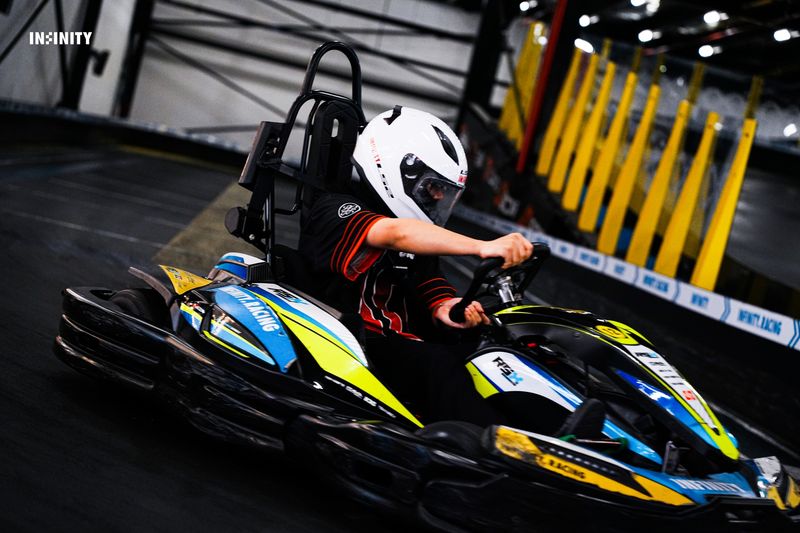
Third is evenness of experience. Outdoor activities like long hikes or kayaking demand fitness and easily leave part of the group feeling left behind. An activity like indoor kart racing lets first-time drivers and experienced ones take part on one track, regardless of physical condition.
When outdoor is still the right choice
Indoor doesn't always win. A group that wants a multi-day summer camp, needs camping space, or has a company culture tied to long-standing outdoor activities may still do better outdoors. The point is that the company needs to know clearly what it prioritizes before paying a deposit.
A specific option in Ho Chi Minh City
The Team Building & Year-End Party package at Infinity Racing is an example of the indoor direction. The three-level kart track at Vincom Thao Dien runs regardless of the weather, and the all-inclusive package already covers racing, food and on-site entertainment. The reference investment is VND 70-100 million (roughly US$2,700-3,900) for an all-inclusive event, depending on group size and number of race rounds.
The venue is inside Vincom Thao Dien, where 20,000-25,000 visitors pass through each day, so there are no costs for guiding the group or finding separate parking. It's a small detail often overlooked in budgeting, though parking fees and shuttles for a group of 100 at an outdoor venue are not a small number.
Four questions to decide faster
When you don't have time for deep analysis, these four questions shorten the decision. First, does the group have more than 50 people? The larger the group, the higher the operational risk outdoors when something goes wrong. Second, is the company organizing between October and December? That is the peak rainy season in the south, and the chance of rain during an afternoon is clearly higher than other months of the year. Third, is the budget fixed at one level, or is there flexibility if extra costs arise? An outdoor plan always needs a contingency sum that may not be used. Fourth, has the company ever had to reschedule team building because of the weather in past years? Real experience is usually a more reliable indicator than any theoretical analysis.
Answering "yes" to two or more of these four is a fairly clear sign the indoor option suits this year better. Conversely, if all four answers are "no," outdoor may still be a reasonable choice, as long as the company has considered the contingency cost carefully from the initial budgeting step and doesn't leave it until the date is close.
Indoor or outdoor team building: related articles
You shouldn't have to make the indoor or outdoor team building decision alone on the strength of this article. If your company has noticed some specific signs it needs to switch to indoor, the article 3 signs your company needs an indoor team building day lists them. If your biggest worry is just rain risk in the year-end season, indoor team building: when rain is no longer a risk goes deeper into that issue alone.
How to decide quickly for this year
If the group is under 150, the budget is set, and the company doesn't want weather risk to affect a date planned well ahead, indoor is the safer option. If the group needs wide space for multi-day activities and has a flexible budget to handle extras, outdoor still has its place. For most companies holding a year-end party in November-December in Ho Chi Minh City, weather risk is the variable hardest to control, and that is also why more and more HR teams are moving fully to the indoor option.
Tell me your group size and preferred timing, and I will send a detailed quote within 24 hours. Send a quote request or book a direct 30-minute call.